Canadian Gold Maple Leaf 2026: Price, Purity and Milk Spots

A 1 oz Canadian Gold Maple Leaf is worth about $3,882.08 as of 4 August 2026, with gold at $4,082.80 per troy ounce. Introduced by the Royal Canadian Mint in 1979, it was the world's first mass-produced 999.9 fine bullion coin, and that purity remains its defining feature. It is also the source of the coin's one real drawback — the milk spotting that Maple Leaf owners debate endlessly. This guide covers current prices at every size, the security features the RCM added in 2013, and how the coin stacks up against a Krugerrand or Britannia.
How much is a 1 oz Gold Maple Leaf worth today?
About $3,882.08 on 4 August 2026, with gold spot at $4,082.80 per troy ounce — roughly €3,372.45 or £2,888.54. The coin contains exactly one troy ounce of fine gold and weighs 31.10 g in total, because at 999.9 purity there is almost no alloy to add. Its melt value therefore equals spot directly.
What does each Gold Maple Leaf size cost?
The RCM strikes the Maple Leaf across an unusually wide range of sizes, including a 25 g coin that few other mints offer. Current prices from stock:
As with every bullion series, fractional coins cost more per ounce because minting cost is spread across less metal. The 25 g coin is a genuinely useful middle option — a little under 0.8 oz — for buyers who want a meaningful unit without stepping up to a full ounce. Browse the full range in our Gold Maple Leaf collection.
Why is the Maple Leaf 999.9 fine and does it matter?
When the RCM launched the coin in 1979 it was struck at 999 fine, and in 1982 the mint moved to 999.9 — the first bullion coin to reach that standard at scale. Some special issues have gone to 99999. In practical terms the difference between 999 and 999.9 gold is commercially negligible: both are refined bullion and trade against the same spot price. What the purity does buy you is instant recognition. A 999.9 stamp removes any question about content, which is part of why the Maple Leaf is accepted worldwide without discussion. The trade-off is physical, not financial — see milk spots below.
What are milk spots and should they worry you?
Milk spots are small whitish blemishes that can appear on the surface of some 999.9 coins, sometimes years after they were minted. They are widely attributed to residue from the minting process reacting over time, and the Maple Leaf has historically been the coin most associated with them. Two things are worth being clear about. First, milk spots do not change the gold content — a spotted coin holds exactly the same troy ounce and sells for the same bullion price. Second, they do matter if you are buying graded or collectible coins, where surface condition drives value. For bullion accumulation, they are a cosmetic issue. If pristine surfaces matter to you, a 22 karat Krugerrand is far more resistant to both spotting and handling marks.
What security features does the Gold Maple Leaf have?
The RCM added two integrated features from 2013 onward, and both can be checked without equipment:
- Radial lines — precision micro-engraved lines radiating from the centre on both faces, cut to a tolerance that produces a distinctive light diffraction pattern and is very hard to replicate
- Micro-engraved privy mark — a tiny laser-etched maple leaf containing the last two digits of the year, visible only under magnification and verifiable against the mint's own register
Together these make the Maple Leaf one of the more straightforward modern coins to authenticate by eye. For a broader walkthrough of verification methods, see our guide on how to spot fake gold and silver.
Maple Leaf, Krugerrand or Britannia — which is the better buy?
All three hold exactly one troy ounce of fine gold and all three are recognised globally. The differences are practical:
| Coin | Purity | Gross weight | Distinctive advantage |
|---|---|---|---|
| Maple Leaf | 999.9 | 31.10 g | Highest purity, radial-line and micro-privy security |
| Krugerrand | 916 (22k) | 33.93 g | Lowest premium, most durable surface |
| Britannia | 999.9 | 31.10 g | CGT-exempt for UK residents |
Choose the Maple Leaf for purity and verifiability, the Krugerrand for the lowest cost per ounce and toughness, and the Britannia if you are a UK resident who will eventually sell at a gain. Every coin listed here can be bought with Bitcoin, Monero, Ethereum or stablecoins, with the price locked at the moment you order and delivery fully insured in plain, unmarked packaging.
Ready to convert crypto into gold?
Buy investment-grade gold and silver with Bitcoin, priced live to the market and shipped fully insured.
Shop bullionFrequently asked questions
How much is a 1 oz Canadian Gold Maple Leaf worth?
What purity is the Gold Maple Leaf?
What are milk spots on a Gold Maple Leaf?
How can I verify a Gold Maple Leaf is genuine?
Is a Maple Leaf better than a Krugerrand?
Related reading
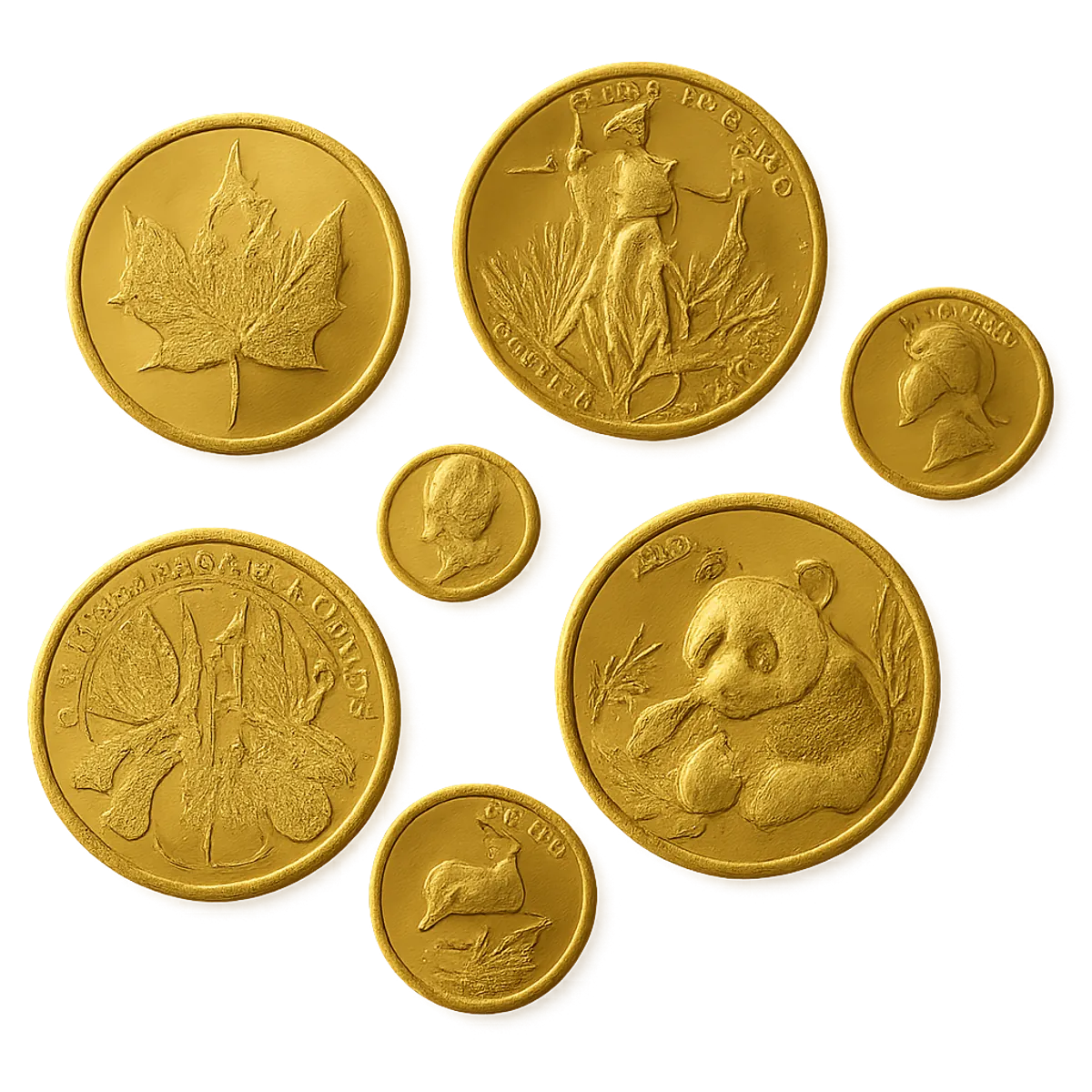
Best Gold Coins to Buy for Investment in 2026
A buyer's guide to the best 1 oz gold investment coins in 2026 — comparing the Maple Leaf, Krugerrand, Buffalo, Britannia and Philharmonic on purity, premium and resale.
Read article →
Gold Coins vs Gold Bars: Which Should You Buy?
Coins or bars? The right choice comes down to premium, flexibility and how much you're buying. Here's a clear, data-backed breakdown.
Read article →
How to Spot Fake Gold & Silver: The 2026 Testing Guide
The tests that actually work for checking gold and silver at home, why tungsten fakes beat most of them, the professional tools that catch them, and the simplest way to never buy a fake.
Read article →